
31 Aug 2026
AS 7531 Rolling Stock Lighting and Visibility – industry update
ARISO is nearing the completion of the targeted review of AS 7531 Rolling Stock Lighting and Visibility, with publication of the Standard expected at end September 2026.
The updated AS 7531 standard will provide operators with clearer, more practical and evidence-based requirements for train visibility. The review focused on the specific recommendations from the Monash Institute of Railway Technology (Monash IRT) research report commissioned by the Office of the National Rail Safety Regulator (ONRSR), together with the requirements and expectations set out in ONRSR’s Code of Practice: Train Visibility at Level Crossings.
It provides clarity on how to meet rolling stock visibility requirements, including how visibility can be measured, demonstrated, and improved across different operating environments.
The review recognises that improving train visibility requires a practical and evidence-based approach. Lighting alone does not address every level crossing risk, particularly in complex environments, at angled crossings, or where vegetation, background clutter, sun glare or other local factors affect a road user’s ability to detect an approaching train.
ARISO’s approach
For this reason, ARISO supports a consistent, national, and performance-based approach that enables operators to select appropriate controls for their rolling stock and operating context as long as it meets the required luminance contrast measurements determined by the recommended luminance contrast testing approach.
Clear, evidence-based, and consistent technical guidance supports operators when selecting the most appropriate controls to improve visibility of their rolling stock for their varied operating environment, ultimately making it easier to meet required luminance contrast measures.
Evidence-led approach
The update has been informed by the ONRSR-commissioned Monash IRT research report released in September 2024, which examined the visibility of locomotive lighting using quantitative luminance contrast measurements. The report highlighted that train visibility depends on more than the brightness of lights. Visibility is also affected by the luminance contrast between the train and its background, the direction and intensity of sunlight, viewing distance, viewing angle, weather, ambient light, livery, reflectivity and cleanliness.
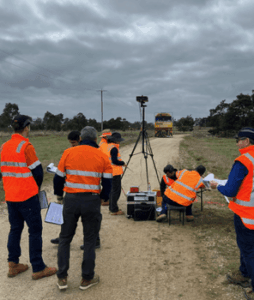
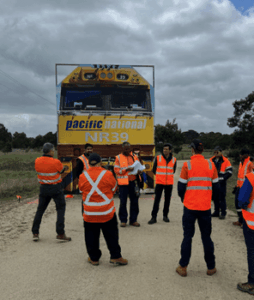
Additional research was also commissioned by ARISO to refine the luminance contrast testing approach. This included the development of a model to support luminance contrast testing measures and to inform the design of field testing undertaken in September 2025. These tests were an important step in establishing a practical methodology for rolling stock operators to demonstrate compliance with AS 7531. The findings from this work have been incorporated into the draft revision.
This approach ensures the standard reflects current industry knowledge, operational needs and good practice, while remaining flexible enough to support emerging technology.
What is changing
The revised AS 7531 provides clearer performance and technical requirements for rolling stock visibility and conspicuity. The key updates include:
- A quantitative measure for rolling stock visibility
The standard now defines luminance contrast as a performance measure for rolling stock visibility.
In simple terms, luminance contrast describes how visually distinguishable the front of a train is from the surrounding background. A train that has higher contrast against its background is more likely to be detected by a road user or pedestrian in time to respond.
Improvement
The updated standard includes minimum visibility requirements for the front-facing areas of leading rolling stock, taking into account the varied backgrounds and environmental conditions in which trains operate.
- Testing methodology for conspicuity performance
The standard includes a testing methodology for measuring luminance contrast. This provides a more consistent way for rail transport operators to assess whether rolling stock is sufficiently visible in relevant operating conditions.
The methodology considers:
- the front-facing area of the leading rolling stock;
- the background surrounding the rolling stock;
- viewing distance and viewing angle;
- lighting configuration;
- environmental conditions such as daylight, night-time, weather and background contrast; and
- the operating context relevant to the rail operator.
Improvement
The methodology is intended to provide operators with a practical method for demonstrating that rolling stock visibility has been assessed using a consistent, measurable approach.
- Lighting requirements and options
The revised standard provides updated specifications for train lighting, including forward-facing lights, visibility lights, beacon lights and side lights.
The intent is to ensure lighting arrangements meet or exceed visibility levels appropriate to how and where trains operate, and address the risks involved. The standard recognises that the effectiveness of different lighting arrangements can vary depending on the operating environment. For example, additional lighting may have different benefits at night, in misty conditions, or at wide viewing angles than it does in clear daylight.
Improvement
The standard therefore supports a risk-based and performance-based approach rather than prescribing a single solution for all rolling stock and all operating environments.
- Livery and reflective materials
The appearance of rolling stock can affect how easily it can be seen from a distance. The revised standard provides more information on how paint colours, patterns, livery arrangements and reflective materials can improve visibility.
This includes consideration of:
- high-visibility colour areas on the front of rolling stock;
- high-contrast patterns and shapes;
- side visibility;
- reflective delineators;
- the use of retroreflective materials to improve night-time and low-light visibility; and
- maintenance factors such as the condition and cleanliness of livery and reflectors.
Improvement
These measures provide operators with a range of options to improve rolling stock conspicuity without relying solely on lighting.
Alignment with the ONRSR approved Code of Practice
The revised AS 7531 supports the outcomes of the ONRSR approved Code of Practice: Train Visibility at Level Crossings.
The Code of Practice provides a nationally consistent means for rail transport operators to comply with the requirements of the Rail Safety National Law to manage risks to safety arising from their operations so far as is reasonably practicable. It requires rail transport operators to assess, document and implement train visibility controls so far as is reasonably practicable, including the use of additional lighting where warranted.
It emphasises that train visibility at level crossings requires a multifaceted approach. This includes level-crossing protection controls, traffic control devices, lines of sight, and train conspicuity. AS 7531 supports the train conspicuity element by providing performance and technical requirements for rolling stock lighting, livery and reflectivity.
The standard is therefore one of the key industry initiatives supporting improved train visibility and reducing the risk of road/rail collisions at level crossings. It also supports the broader objectives of the National Level Crossing Safety Strategy and is an important part of compliance with the Code of Practice, which ONRSR is monitoring.
What this means for rail transport operators
AS 7531 provides rail transport operators with:
- a defined performance measure for rolling stock visibility and conspicuity;
- technical requirements for rolling stock lighting, livery and reflectivity;
- a methodology for measuring luminance contrast;
- guidance on environmental and operating factors that influence visibility;
- options for improving visibility based on the operator’s risk profile; and
- a framework that supports emerging technologies and alternative controls where they can achieve the required performance outcome.
This means operators can choose the most effective controls to improve rolling stock visibility for their operating environment and based on their risk assessments. These controls may include lighting, livery, reflective materials, maintenance practices, operational procedures or other measures that improve conspicuity.
Recognising community concerns
ARISO recognises the strong community concern about safety at level crossings and the impact of level crossing collisions on families, communities, rail workers, road users, and the wider transport sector.
The update to AS 7531 is intended to provide a clear, measurable and practical pathway for improving rolling stock visibility. It does not replace the need for broader-level crossing risk management, including line-of-sight management, road-and-rail interface coordination, traffic control devices, vegetation management, and other controls. Rather, it strengthens the rolling stock component of that broader safety system.
Note on composition of the AS 7531 Development Group
The representation on the Development Group was diverse, including both road and rail representatives, subject matter experts from industry and academia and those with a significant interest in the standard, reflecting a strong commitment to both technical rigour and practical application.
Participants include representatives from:
- Rail operators and track managers
- Rolling stock manufacturers
- Engineering and design consultants
- Government agencies and regulators
- Road managers and industry bodies
- Unions
- Research institutes
- Subject-matter experts in lighting and optical systems
- An independent consultant on behalf of public interest groups
Next steps
The draft revision of AS 7531 has been developed through industry consultation and technical review. Stakeholder feedback is an important part of ensuring the standard is practical, evidence-based and capable of supporting improved safety outcomes across the rail industry.
A total of 31 technical submissions were received during public consultation on the draft standard, in addition to the 17 general submissions – totalling 600 comments for the development group to work through.
Significant commentary was received regarding the instruction on the conspicuity measurement methodology. The focus of this commentary was the consistent application of the measurement methodology by the industry, enabling consistent regulatory activities.
The industry has also requested the development of supporting guidance material for implementation. This guidance is expected to include practical advice, worked examples and possible case studies to assist operators in applying the revised standard in different operating contexts.
ARISO continues to work with rail transport operators, ONRSR, government, unions, technical experts, manufacturers, and other stakeholders who are part of the development group to finalise the standard and support its implementation. Additional work required means the standard is anticipated to be delivered by the end of September 2026.
ARISO remains committed to developing standards that support safer, more consistent and more effective rail operations across Australia.